

If you’re going to clean jewelry in an ultrasonic cleaner, there are two questions you should ask—before running the cleaner. One: does the device clearly state that jewelry can be cleaned in it? Two: what is the value of the jewelry you’re about to drop into that tank?
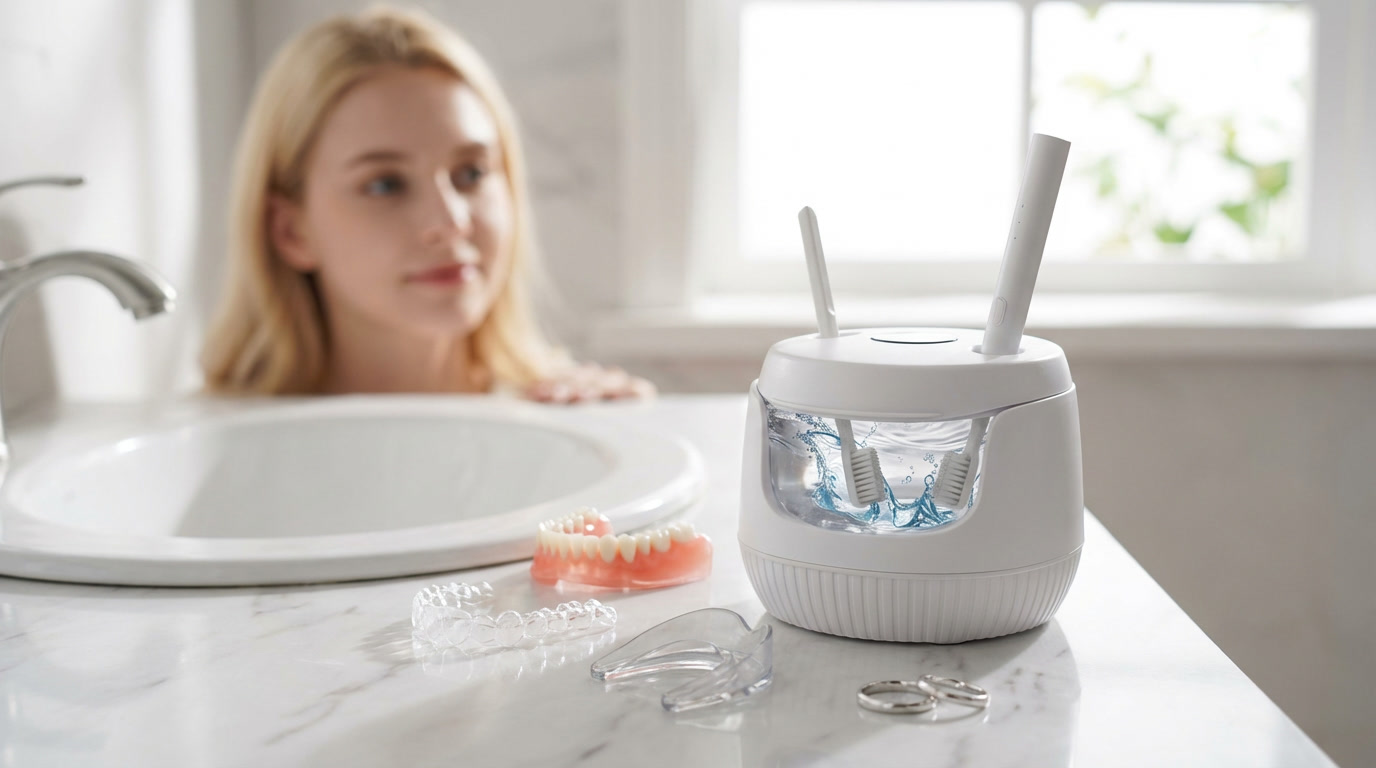
If you own a dedicated ultrasonic jewelry cleaner, the safest place to start is by reading the manufacturer’s instructions. But if you’re using a retainer cleaner or a hybrid ultrasonic cleaner—one marketed for retainers, dentures, mouth guards, toothbrush heads, and jewelry—there are a few important things to consider before dropping anything valuable into the tank.
For example, take the Zima ultrasonic retainer cleaner. Despite its popularity, jewelry is not mentioned in its manufacturer documentation. Zima focuses exclusively on dental devices, such as retainers, mouthguards, and dentures.
The ultrasonic cleaner I use for jewelry is the UEOFEN ultrasonic cleaner. It’s a hybrid ultrasonic cleaner. And when I recommend it to patients as a cheaper alternative to the Zima, at least 50 percent tell me in the months that follow that they’ve also used it to clean their jewelry.
That said, the device sells 40,000+ units a month, and the manufacturer documentation explicitly lists jewelry. Likewise, over and over, reviews say things like “I cleaned my ring,” “I dropped my necklace in,” or “my jewelry came out spotless.”
Disclosure: This post is sponsored through Amazon Creator Connections, and I may earn compensation at no extra cost to you.

How to Clean Jewelry Using the UEOFEN Ultrasonic Cleaner
As a dentist, I clean many oral devices in ultrasonic cleaners. But there’s a right and a wrong way to clean jewelry in ultrasonic cleaner devices at home.
To use it safely, place the jewelry in the tank so pieces do not touch, fill the tank with water, and run a short cycle. Jewelry should not touch during an ultrasonic cycle because the vibrations cause pieces to strike each other, which can lead to fine scratches. Keeping pieces separated also allows the ultrasonic waves to clean all surfaces evenly and reduces the risk of stones working loose.
The UEOFEN has two cycle modes that you can choose between before starting a cleaning cycle: a 5-minute quick clean and a 10-minute deep clean.
Here’s how it works:
5-Minute Mode – A shorter cycle designed for everyday cleaning of dental devices like retainers, mouth guards, and dentures.
10-Minute Mode – A deeper cycle with pulsed ultrasonic action (on for 2 seconds, off for 1 second), which is intended to help remove heavier residue.
You select the mode by pressing the control button once for the 5-minute cycle and twice for the 10-minute cycle.
Both modes operate ultrasonic vibration and UV sanitation together.
For jewelry, if you’re using the UEOFEN, the safer setting is almost always the 5-minute cycle.
Here’s why:
5-Minute Setting—Best for Jewelry
- There’s less cavitation stress on metals and stone settings
- A shorter setting reduces the risk of loosening stones, especially in rings or pendants
- There’s enough time to lift everyday dirt, oils, and residues
- Most importantly, shorter cycles are the standard recommendation for most jewelry ultrasonic cleaning
Experienced jewelers using ultrasonic devices typically run short bursts (2–5 minutes) and then inspect the piece. This approach limits potential damage while still cleaning well.
10-Minute Setting—Use With Caution
The longer cycle is designed for heavier residue on dental devices, not jewelry. If you use it on jewelry:
- It may be okay for solid metals and secure stones (diamonds, sapphires, platinum)
- It increases the risk for softer stones (pearls, opals) or glued settings
- It’s rarely necessary unless the piece is especially grimy
In fact, unless you’ve spoken directly to UEOFEN’s customer support and described the exact piece, longer cycles can cause damage. And when jewelry costs hundreds—or thousands—of dollars, err on the side of caution.
After the Cycle
Always rinse your jewelry with clean water and dry it with a soft cloth. That prevents residue from settling back on the surface, which can make it look cloudy even after a proper ultrasonic run.
Which Jewelry Is Safe vs Unsafe
If you’re ever in doubt about whether a piece is safe to clean, contact UEOFEN’s 24-month service support. You can describe the jewelry in detail—and even send a photo—so they can advise you before you place anything valuable in the tank.
Generally safe for ultrasonic cleaning
- Solid gold and platinum
- Sterling silver
- Diamonds with secure settings
- Stainless steel jewelry
Not safe for ultrasonic cleaning
- Pearls
- Opals
- Emeralds
- Turquoise
- Amber
- Costume jewelry
- Any jewelry with glued stones
- Jewelry with cracks, chips, or loose settings
Ultimately, cleaning jewelry in ultrasonic cleaner machines works best with gold, platinum, sterling silver, hard gemstones, and secure settings. But if a stone is porous, soft, glued, or naturally fractured, ultrasonic vibration can damage it. When in doubt, do not place it in the cleaner.
What Solution to Use
For most jewelry, plain water is sufficient.
For heavier grime:
Add one or two drops of mild dish soap to warm water or use a safe jewelry ultrasonic cleaning solution. That said, too much detergent can leave residue and cause cloudiness.
Above all, never use the following to clean jewelry:
- Bleach
- Ammonia
- Vinegar
- Abrasive cleaners
- Harsh chemical jewelry solutions, unless specifically labeled ultrasonic-safe
Common Mistakes to Avoid
I’ve never personally spoken to anyone who has damaged a piece of jewelry in an ultrasonic cleaner, but according to manufacturers of ultrasonic cleaners, these are the mistakes to avoid:
- Running the cleaner too long
- Letting jewelry pieces touch each other
- Cleaning fragile or porous stones
- Using harsh cleaning chemicals
- Cleaning jewelry with loose settings
- Assuming “more time” equals “better results”
When done properly, cleaning jewelry in ultrasonic cleaner devices can restore shine without harsh scrubbing, but misuse can cause damage quickly.
Why Jewelry Looks Cloudy Afterward
Cloudiness after ultrasonic cleaning usually happens for one of these reasons:
- Soap residue left behind
- Minerals in tap water drying on the surface
- Oils lifted but not rinsed away
- Micro-scratches revealed by deep cleaning (long cycles)
That said, rinse your jewelry thoroughly with clean water after the cycle and dry with a soft cloth. If cloudiness remains, the issue may be wear, not dirt.
The Bottom Line
You might consider a dedicated jewelry ultrasonic cleaner if you’re using it specifically for hard gemstones like diamonds, sapphires, rubies, or moissanite. And if you wear jewelry regularly, you’ll know how quickly residue builds up in places a soft brush never quite reaches. In that case, it often makes sense to use one ultrasonic cleaner for jewelry and a separate one for retainers and oral devices.
Cleaning Jewelry in Ultrasonic Cleaner FAQs
What is the best jewelry ultrasonic cleaner?
If you want a dedicated jewelry ultrasonic cleaner, the Onlikin ultrasonic cleaner is a popular choice. It’s designed specifically for jewelry and works well for rings, necklaces, and earrings with hard gemstones and secure settings.
If you’re looking for a hybrid clear (oral appliances and jewelry), the UEOFEN ultrasonic cleaner is the #1 Best Seller in Retainer Cleaners, but it’s designed for all dental appliances and jewelry. Cleaning jewelry in ultrasonic cleaner units is one of the most effective ways to remove buildup from hard-to-reach settings.
What is the best jewelry ultrasonic cleaning solution?
For most at-home use, a mild solution works best. Many people use plain water with a drop of gentle dish soap, but if you prefer an actual jewelry solution, the iSonicUltrasonic Jewelry Cleaning Solution available on Amazon is made specifically for ultrasonic devices. It’s gentle on metals and stones when used as directed. And many people are surprised by how thorough cleaning jewelry in ultrasonic cleaner devices can be when used correctly.
Can you clean jewelry in an ultrasonic retainer cleaner?
Yes, you can—if the retainer cleaner is designed as a hybrid unit (oral appliances and jewelry) and the manufacturer explicitly lists jewelry as a compatible item. Not all retainer cleaners do. When they do, they typically operate at safe frequencies and use gentle cavitation suitable for durable metals and hard stones. For everyday wear pieces, cleaning jewelry in ultrasonic cleaner baths can remove residue that brushing misses.
Can you put expensive jewelry, like a wedding or engagement ring, in an ultrasonic retainer cleaner?
In many cases, yes—but be cautious. Solid gold or platinum rings with diamonds or other hard gemstones are generally safe when the setting is secure and cycles are kept short. If there’s any doubt, it’s best to confirm with the manufacturer or jeweler first. People often turn to cleaning jewelry in ultrasonic cleaner systems when soap and a soft brush stop working.
Author

Dr. Rossouw holds a BChD (Pret), HONS (Medunsa), and MChD (Medunsa), completed cum laude. He is an Associate Professor with 12 publications and a professional background spanning public health, epidemiology, health systems, and health economics.
He has consulted to SADC countries in epidemiology and health economics, served as Clinical Director at the Institute for Health Economics and Technology Innovation, and was registered as a specialist in Public Health, Health Systems, and Epidemiology.